"I really enjoy helping civil engineering companies make either our roads or foot path areas safer for people whether they are walking or driving.
With so much urban development taking place in nearly every state of Australia it is so important to keep an eye on safety at all times"John Ford - ENCAT Managing Director

ENCAT manufactured one our Fasterail partial balustrade systems to improve the safety of an underpass adjacent to a river. ENCAT was recently engaged by Wollongong City Council to supply and deliver this safety barrier solution to be used for the Windang Cycleway Bridge underpass located at the northern end of the bridge where the entrance and outlet waters of Lake Illawarra flow rapidly.
The council identified the need to install a barrier to prevent pedestrians and cyclists who use the shared path from falling onto the exposed rocks and into the fast-moving tidal waters. Given the site’s exposure to salt-laden air and frequent wetting, corrosion resistance and long-term durability were key factors in the selection of materials to be used for the barrier system chosen.
Hot dip galvanised versus Zinc plated balustrade anchors
To address the council’s requirement, ENCAT supplied our Fasterail Partial Balustrade System. This is a modular, weld-free balustrade product that has been widely adopted across public infrastructure projects due to its ease of installation, aesthetic design, and cost-efficiency.
For this site, the client specified hot dip galvanising as the finish for all exposed steel components, ensuring superior resistance to corrosion in the harsh coastal environment.
Importantly, as civil engineers, ENCAT also specified hot dip galvanised concrete anchors for fixing the posts into the substrate. This is a critical detail that is often overlooked by other suppliers, many of whom mistakenly use Zinc-plated anchors in marine-adjacent locations. While Zinc plating (electrogalvanising) provides a thin layer of corrosion protection, it is not suitable for high-salinity areas like Windang.
Hot dip galvanising, by contrast, involves immersing the steel in molten zinc, forming a thick, bonded coating that resists rust far more effectively and ensures a longer service life with minimal maintenance.
From order placement to delivery, ENCAT completed the supply in just two weeks, meeting council timeframes and delivering a fully compliant safety barrier that enhances public safety without compromising on visual appeal. Just as important will be the durability the whole system provides.
This project is another example of how ENCAT’s engineering-led, modular railing systems provide practical, long-lasting solutions for councils, developers, and civil contractors working in demanding environments.
Why would a pathway require a partial rail, three-rail or full balustrade in Australia?
A pathway will require a form of safety barrier depending on the location and potential safety risks of the environment.
Fall Hazard Risk – AS 1170.1 & AS/NZS 1657
According to AS 1170.1 (Structural Design Actions) and AS/NZS 1657 (Fixed Platforms, Walkways, Stairways and Ladders), if there is a drop greater than 1 metre adjacent to a walkway or platform that is accessible to the public, a barrier must be installed to prevent falls. Even a lower drop may warrant protection if the surface below is considered hazardous like this example which is a rocky riverbank or fast flowing water.
Public Safety & Duty of Care – WHS Obligations
Under Work Health and Safety (WHS) legislation, asset owners (e.g. councils or developers) have a legal duty to ensure that public infrastructure is safe for use and that foreseeable risks are reasonably controlled. This could include (but is not limited to);
- Slippery surfaces from water splash or moss
- Unprotected vertical drops
- Rapid water flow, particularly after rain
A balustrade helps mitigate these risks, particularly for children, cyclists, or pedestrians.
Austroads Guide to Road Design – Part 6A: Pedestrian and Cyclist Paths
The Austroads Guide recommends that where shared paths or pedestrian footpaths are adjacent to hazards such as water bodies, appropriate barrier systems should be used. The design must consider sight lines, accessibility, and risk exposure.
AS 2156 – Walking Tracks
While primarily for bush and recreational tracks, AS 2156 identifies that when tracks are close to steep embankments, fast-moving water or drop-offs, handrails or guardrails are required to ensure user safety. These principles apply to shared use or public footpaths in high-risk settings.
Other environmental and site-specific assessments
Environmental factors may also play a role, for example, tidal movements, erosion, or floodwater surges can undermine footpath integrity over time, increasing the risk of slips or collapse near the edge. In these cases it would create the need for discussions to be had for the installation of engineered barriers to form part of the hazard mitigation strategy for that area.
The installation of a safety barrier or balustrade along a concrete footpath near a river is not just a design preference, this type of installation is often required by Australian Standards, risk management protocols or civil infrastructure guidelines.
It protects the public from predictable hazards and ensures the asset owner meets their legal and safety obligations.
Unique design elements of our partial balustrade system
Stainless steel structural material
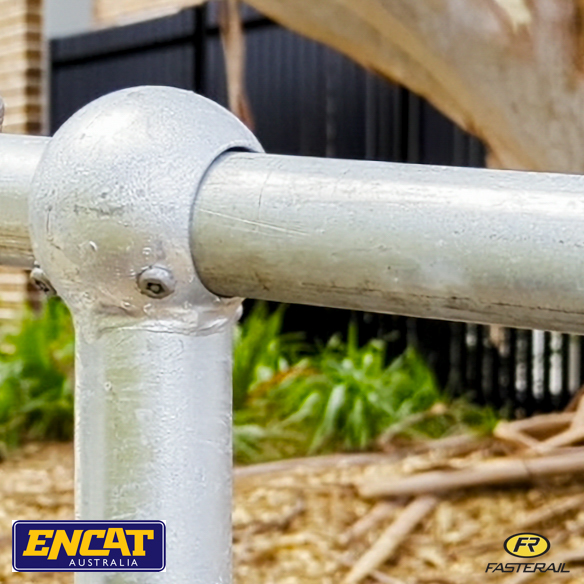
ENCAT is an Australian manufacturer of handrails. Our no-weld modular designs mean there is no need for hot works permits, no toxic fumes & no site shutdowns required. Together with the durable design that we have developed in Australia, our system delivers the lowest total cost of ownership in the industry.
We consider every aspect including the handrail’s ability to handle Australian weather conditions & ensuring that any installation is tamper proof by using Pentaforce tek screws instead of easy to access alternatives found in competitor products.

Cost-effective and modular
Our products will help you save money compared to the typical high costs associated with traditional welded handrails and balustrades. With Fasterail, you eliminate the need for complex design or on site production which reduces your upfront expenses.
Our pre-fabricated modular components streamline the installation process, allowing for faster project completion, reduction in labour costs as well as long term reductions in maintenance requirements.
Quite simply, removing the need for onsite welding means fewer delays and a more predictable project timeline.
Our system helps to protect the environment while also being easy to install on site and in this example it had to be made to sit low to the ground.


Learn more about our civil use balustrade and handrail products
ENCAT regularly works with civil works contractors, local or state government departments or national parks services to design, manufacture and install civil use structures to suit any type of application or existing site. We have been doing this since 1989
Learn more about our range of products