"I am proud of the strict timelines our team can work to, especially in very busy public environments like the airport. To see the public travel in safety and comfort gives us great satisfaction."
John Ford - ENCAT Managing Director


ENCAT was engaged to manufacture and install these shelters on the basis of our demonstrated capability to supply structurally certified, DDA-compliant bus shelter infrastructure together with the track record we have at Sydney Airport itself having previously supplied shelters of the same design to the international terminal long-term car parking facility.
- Structural engineering certification for airport conditions
- DDA compliant design to AS 1428 Series
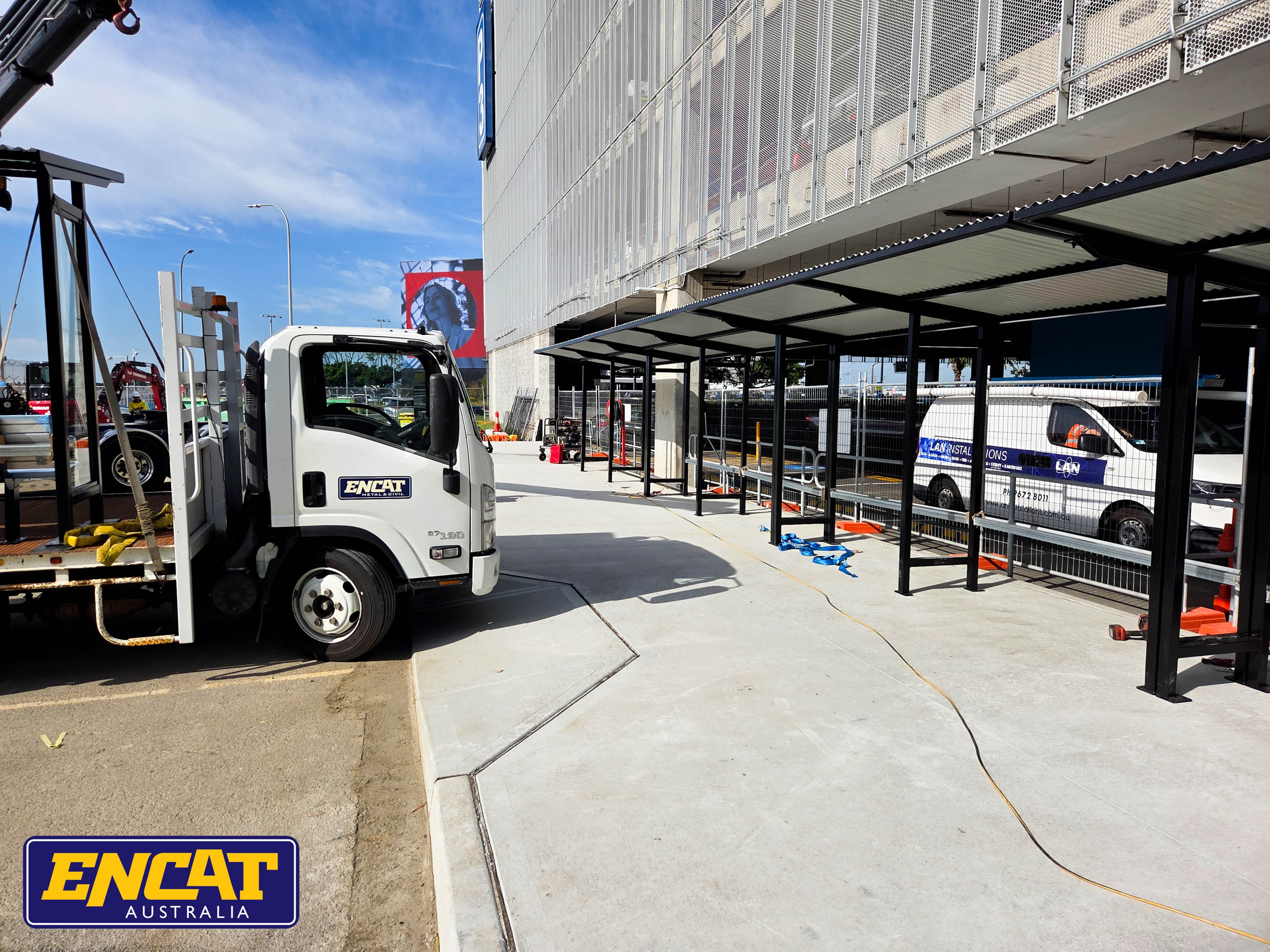
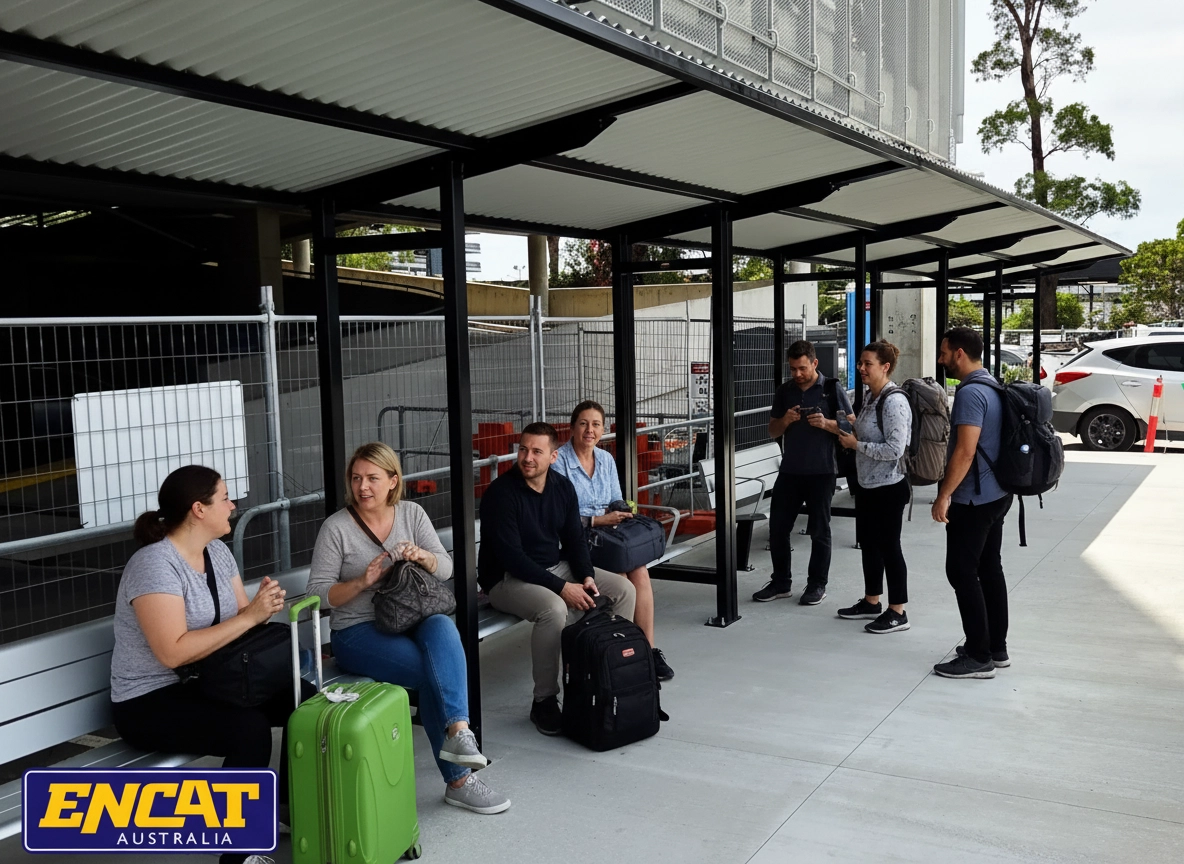
- Five-shelter continuous facility configuration
- Anodised aluminium DDA compliant seating
- Toughened glass end panel supply
- CNC tube laser cutting — sub-millimetre tolerance
- Certified welding to AS 1554 Part 1
- Two-coat powder coating — zinc primer + colour topcoat
- Fully assembled delivery by semi-trailer
- Crane installation to concrete slab
- Complete five-shelter installation in a single day
Sydney Airport engaged Fulton Hogan as principal contractor for infrastructure upgrades associated with the T3 Domestic Terminal shuttle bus transfer facility which is the point of departure and arrival for passengers transferring between the T3 Domestic and T1 International terminals.
The facility serves a high-volume, time-sensitive passenger cohort that includes both domestic travellers connecting to international departures and international arrivals transferring to domestic onward flights, with shuttle buses operating from early morning through to late evening throughout the year.
Fulton Hogan required a bus shelter solution that could meet the operational and regulatory demands of one of Australia’s highest-traffic public transport interchange points. The shelters were required to be DDA compliant, structurally certified for the specific site conditions, capable of being configured as a continuous waiting facility across five bays, and deliverable within a construction programme that allowed no tolerance for delay.
Manufacture of a five bay bus shelter waiting facility at Sydney Airport

The project required the supply and installation of five individual bus shelters configured in sequence to create a single, continuous passenger waiting facility along the shuttle bus kerb. The continuous arrangement ensures that passengers are protected from the elements across the full length of the waiting zone, while maintaining open sightlines between bays to support passenger flow management and security observation. These are requirements that are particularly important in an airport environment where the movement of large, time-pressured passenger groups must be managed safely and efficiently.
- DDA Compliant Design & Seating
All five shelters were designed and supplied in accordance with the DDA compliance requirements applicable to public transport infrastructure in New South Wales. DDA compliance at bus shelter facilities encompasses not only physical access and clearance requirements for wheelchair users, but also seating configuration, approach paths, and tactile and visual accessibility provisions that ensure the facility can be used safely and independently by passengers with a range of mobility and sensory impairments.
The seating supplied within the shelters was fabricated in anodised aluminium which is a specification chosen for its combination of comfort, durability, and low maintenance requirements in a facility that operates under high passenger volumes seven days a week.
Anodised aluminium seating is resistant to corrosion, graffiti, and the physical wear associated with continuous public use, and requires none of the periodic painting or coating maintenance that would apply to alternative materials.
The finish was also selected for its aesthetic quality, consistent with the expectation of a major international airport that public-facing infrastructure reflects the visual standards of the broader terminal environment.
- Glass End Panels
Each shelter was fitted with glass end panels to provide weather protection against wind and rain at the open ends of the waiting facility. In an exposed outdoor environment servicing an active bus kerb, glass panels were specified in preference to solid or mesh alternatives due to their ability to provide weather protection while maintaining clear sightlines thus allowing passengers to observe approaching buses and assisting airport staff and security personnel with visibility across the waiting area.
- Structural Engineering Certification
ENCAT provided structural engineering certification for all five shelters specific to the Sydney Airport site conditions.
Airport infrastructure is subject to loading conditions and design standards that differ from standard roadside or council applications, including requirements that account for the specific exposure conditions, substrate characteristics, and traffic environment of the site.
The provision of formal structural certification gave Fulton Hogan and Sydney Airport the documented technical assurance required for a major infrastructure project at a nationally significant facility, and is a capability that distinguishes ENCAT from suppliers who manufacture standard catalogue products without site-specific engineering support.
A high quality manufacturer of bus shelters in NSW
All five shelters were fabricated entirely within ENCAT’s Wollongong facility, with no component manufacture or finishing subcontracted to third parties.
- Precision CNC Tube Laser Cutting
All structural components were cut using ENCAT’s in-house CNC tube laser cutting system. Computer-controlled to sub-millimetre tolerances, the tube laser produces components from a fixed digital file, ensuring dimensional consistency across all five shelters.
For a project requiring five units to align as a continuous facility, this level of precision is not merely a quality consideration, it is a functional requirement.
Components that are dimensionally inconsistent between units would produce visible misalignment in the finished installation, compromising both the structural and aesthetic outcome. The tube laser eliminates this risk by guaranteeing that every component across all five shelters is cut to identical specifications. - Certified Welding to AS 1554 Part 1
All welded joints were completed by ENCAT’s qualified welders in accordance with AS 1554 Part 1. For infrastructure installed at a major airport and subject to continuous high-volume passenger use, certified welding provides the structural assurance required by both the principal contractor and the airport authority.
It also provides the documentary evidence of process compliance that is typically required as part of the quality management framework for works at nationally significant facilities. - In-House Two-Coat Powder Coating
The completed shelters were processed through ENCAT’s in-house powder coating plant using a two-coat system. A zinc-rich primer coat was applied to all steel surfaces as the first stage, providing a sacrificial corrosion barrier across the full surface of the structure. A colour topcoat was then applied to the customer’s specified colour.
Processing all five shelters within ENCAT’s own facility ensured that both coats were applied under consistent conditions across every unit, with uniform film thickness and finish quality — an outcome that is critical when five shelters will be installed side by side and any variation in finish would be immediately visible.
Bus shelters delivered and installed in NSW
The logistical demands of delivering and installing five large bus shelters at an operational international airport required careful coordination between ENCAT, Fulton Hogan, and Sydney Airport’s site management team. The approach taken was designed to minimise the duration and footprint of on-site activity, protecting the safety and operational continuity of the surrounding construction programme.
- Fully Assembled Transport by Semi-Trailer
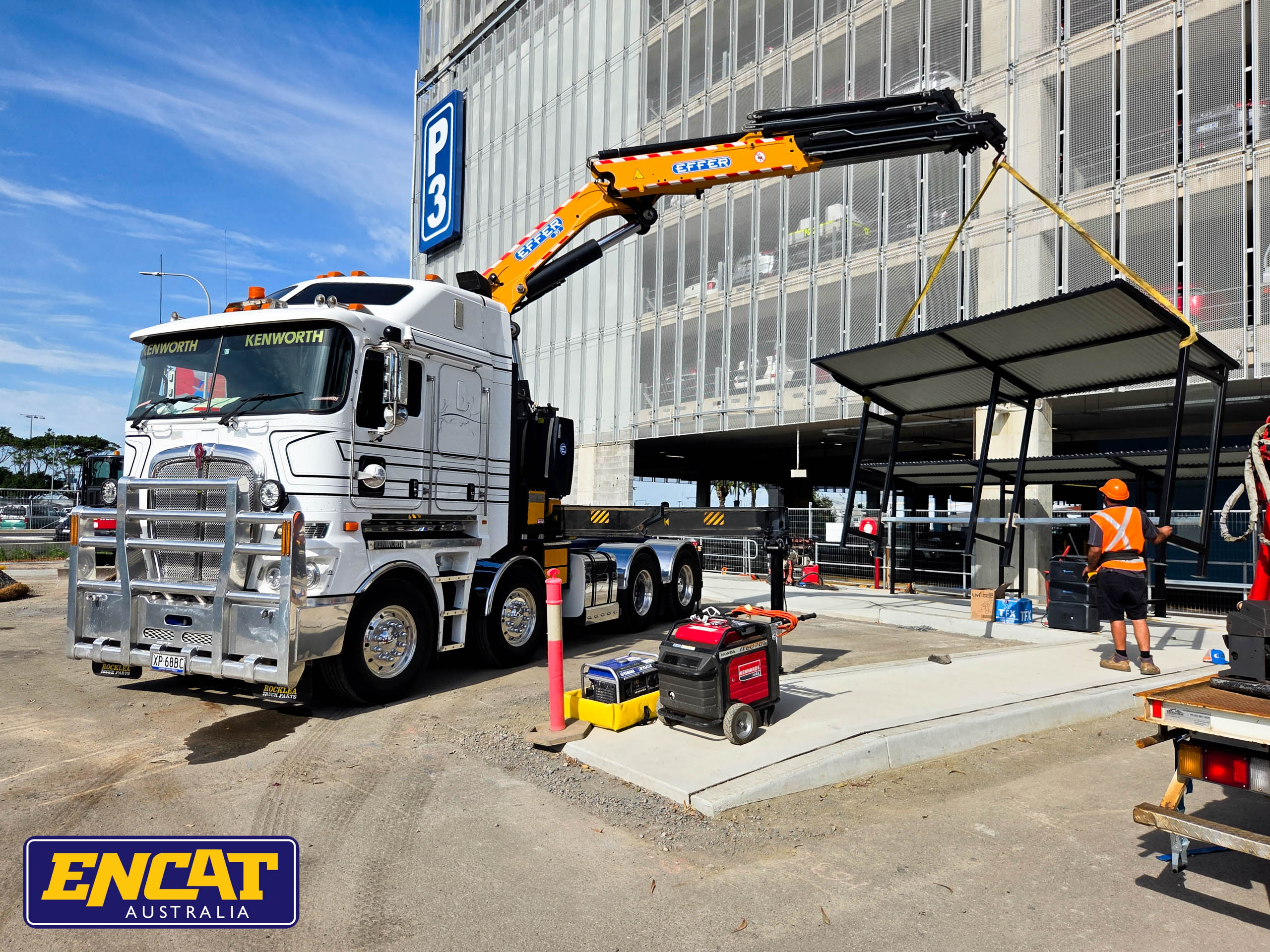
All five shelters were transported to the Sydney Airport site fully assembled on semi-trailer vehicles. Delivering the shelters in a completed state eliminated the requirement for on-site assembly, significantly reducing the time that the installation team needed to occupy the work zone and the number of personnel required on site.
For an airport construction environment where access windows, crane bookings, and traffic management approvals must be carefully managed, the reduction in on-site activity time directly translates to reduced programme risk and lower overall project cost.
- Crane Installation — Completed in a Single Day
On arrival at the site, each shelter was crane-lifted from the transport vehicle and placed into its final position on the prepared concrete slab.
The shelters were then anchored using chemical set (chemset) fixings, providing a high-strength, vibration-resistant connection to the substrate appropriate for infrastructure subject to ongoing heavy vehicle traffic and the associated dynamic loading of an active bus facility.
The complete installation of all five shelters — including transport, craning, positioning and fixing — was accomplished within a single working day.
This outcome was a direct consequence of the fully assembled delivery approach combined with ENCAT’s experienced installation team and the precision of the manufactured components, which required no on-site adjustment or remedial fabrication.
Completing the installation in one day minimised disruption to the surrounding construction works and allowed Fulton Hogan to return the area to the broader construction programme without delay.
Learn more about our range of bus shelters

ENCAT’s engagement on the T3 Domestic Terminal shuttle facility was not the company’s first involvement with Sydney Airport infrastructure.
The shelter design supplied for this project is the same design previously specified and installed at the Sydney Airport international terminal long-term car parking facility — a prior engagement that provided both ENCAT and Sydney Airport with confidence in the product’s performance in the specific environmental and operational conditions of the airport precinct.
The prior installation record at the international terminal also provided Fulton Hogan with documented evidence that the product had been accepted and approved by Sydney Airport for use within the facility — reducing the procurement risk associated with specifying an unproven product for a high-profile infrastructure project.
For principal contractors managing complex programmes at major facilities, the ability to reference existing approved installations within the same asset is a significant factor in supplier selection.
The five-shelter continuous waiting facility was delivered and installed within Fulton Hogan’s required programme timeframe. The completed installation provides a fully DDA compliant, structurally certified, and weather-protected passenger waiting environment at one of Australia’s busiest domestic terminal shuttle bus facilities — serving the daily transfer requirements of thousands of passengers connecting between Sydney Airport’s domestic and international terminals.
The project demonstrates ENCAT’s capacity to deliver bus shelter infrastructure at the scale, quality standard, and programme certainty required by major civil contractors working at nationally significant facilities. The combination of structural engineering certification, DDA compliance, precision manufacture, fully assembled delivery, and single-day installation represents a complete end-to-end capability that is available to principal contractors, government agencies, and airport authorities as a single-supplier engagement.
ENCAT has been designing, manufacturing and installing bus shelters for local councils, state government agencies, civil works contractors and major infrastructure projects across Australia since 1989.
With over 500 shelters supplied in New South Wales alone, and installations ranging from rural school bus stops to Sydney Airport’s domestic terminal, ENCAT has the manufacturing capability, compliance knowledge and project delivery experience to meet the requirements of any bus shelter application.
Learn more about our range of bus shelters.