
Sirius Double Bus Shelter by ENCAT


- 100% DDA Compliant by design
- Zero failures from 500+ installs over 30+ years
- AS4100 & AS1170 as standard
- Full in-house manufacture in Australia
- Delivered fully assembled
- Installed in little as 1 hour on site
- Supplied to Sydney Airport, councils, rural schools & everywhere in between since 1989
Availability:
Lead time 7 to 14 business days from time of order

SAFETY COMPLIANT
DESIGN

FACTORY DIRECT,
100% AUSTRALIAN MADE

DELIVERED ANYWHERE
IN AUSTRALIA

CUSTOM SIZES FOR
ANY SITE
Australia's most specified DDA compliant bus shelter


This modular bus shelter system makes it easy to create large scale passenger waiting areas suitable to any length of roadway or footpath with seating for up to eight people per module. This bus shelter is designed for footpaths, verges, and roadside locations where space is limited but compliance cannot be compromised. Engineered to meet DDA requirements it is one of the best DDA compliant bus shelters available in Australia which makes it the practical choice for councils that need to deliver an accessible, compliant waiting facility within a constrained site envelope.
Manufactured at ENCAT’s Wollongong facility and structurally certified to AS4100 with wind loading designed to AS1170, this bus shelter is built for permanent outdoor use in Australian conditions. Our shelter designs have been in continuous production with more than 500 units installed across New South Wales with thousands of travellers using them every day.
Key features
- Suitable sizing with roof overhang providing effective weather protection
- DDA compliant design and seating, meeting the requirements of the Disability Discrimination Act 1992
- Structurally engineered and certified to AS4100 and AS1170 wind loading
- DDA compliant seating with back and armrests — or bench seat configuration available
- Colorbond roof sheeting, purpose-shaped for rapid rainwater dispersal without requiring guttering
- Glass back panel for clear sightlines — assisting bus drivers to identify waiting passengers and supporting personal safety at the stop
- 2.6 metre height deters climbing and anti-social use
- Choice of supply only, or supply and installation anywhere in Australia
- Optional custom powder coat colour — any colour from ENCAT’s full range including custom matches
- Optional advertising panel provision available
- Optional tactile ground surface indicators available on request
- Optional lighting provisions (installed in coordination with a client’s electrical contractor)
- Optional drainage and guttering on request
- Custom design or modifications available to suit specific requirements.
Sirius Double Bus Shelter Specifications

| Specifications | |
Width | 4810mm |
Depth | 1350mm (one side) |
Roof overhang | 1924mm |
Height | 2600mm |
Seating capacity | 5 persons |
Seating options | DDA compliant seat with back and armrests / bench seat |
Roof material | Colorbond Custom Orb sheeting |
Frame material | Tube steel — galvanised, powder coated |
Finish | Two-coat system: zinc primer + powder coat colour topcoat |
Glass | Toughened laminate — compliant with Australian Standards for bus shelter applications (where specified) |
Fixings | Vandal-resistant fixings as standard |
Colour | Any colour from ENCAT’s powder coat range, including custom matches |
Compliance | DDA compliant — Disability Discrimination Act 1992 |
Structural certification | AS4100 structural steel design / AS1170 wind loading |
Welding | Certified to AS1554 Part 1 |
Galvanising | To AS4680 where specified |
Powder coating | To AS4506 |
Availability | Made to order — lead time 7 to 14 business days |
Supply options | Supply only / Supply and installation |
Options
Tactile ground surface indicators (TGSIs)
Advertising panel provision
Custom branding
Lighting provisions (installed in coordination with client’s electrical contractor)
Drainage and guttering (on request)


Outdoor bus shelter colour choices


An experienced Australian bus shelter manufacturer
30 years. 500+ shelters. Zero failures.
ENCAT has been designing and manufacturing bus shelters in Australia since 1989. In that time we have supplied more than 500 Sirius shelters across New South Wales — to local councils, state government agencies, civil works contractors, national parks, schools, and major infrastructure projects including Sydney Airport’s domestic terminal shuttle facility.
The Sirius range has not recorded a single vandalism or failure incident in over 30 years of service. That is not a coincidence, it is the result of deliberate design choices that have been tested and refined across hundreds of real-world installations in Australian conditions.
What sets ENCAT apart
- Structural engineering certification on every shelter.
All ENCAT bus shelters are structurally certified to AS4100 and wind-rated to AS1170 — a formal engineering credential that most bus shelter suppliers do not provide, and that is increasingly required in council and government procurement processes.
- Fully in-house manufacture.
Design, CNC tube laser cutting, certified welding, and two-coat powder coating all take place at our Wollongong factory. Nothing is subcontracted. This gives us complete control over quality, lead time, and delivery — and a single point of accountability for every shelter we produce.
- DDA compliance by design, not by addition.
Every Sirius shelter is designed from the ground up to meet DDA requirements. Compliance is not an optional upgrade — it is the standard.
- On-going support.
ENCAT supplies replacement components to councils and contractors for shelters damaged in service, and carries out on-site repairs where required. We manufacture locally, which means parts are available and lead times are short.
For an obligation-free discussion about your project, contact our team or submit a quote request.
Bus shelters that can be used together with other civil use products
Our modular bus shelter can be matched to our range of Pedestrian Fencing to create a complete solution for managing public transit areas.


View our range of bus shelter products


See examples of our recent installations we have helped to complete

A regional bus shelter for designated school pick up
Bathurst Regional Council required a bus shelter at a designated school bus pick-up and set-down area servicing children from farming properties along Timber Ridge Road, Wallangs.
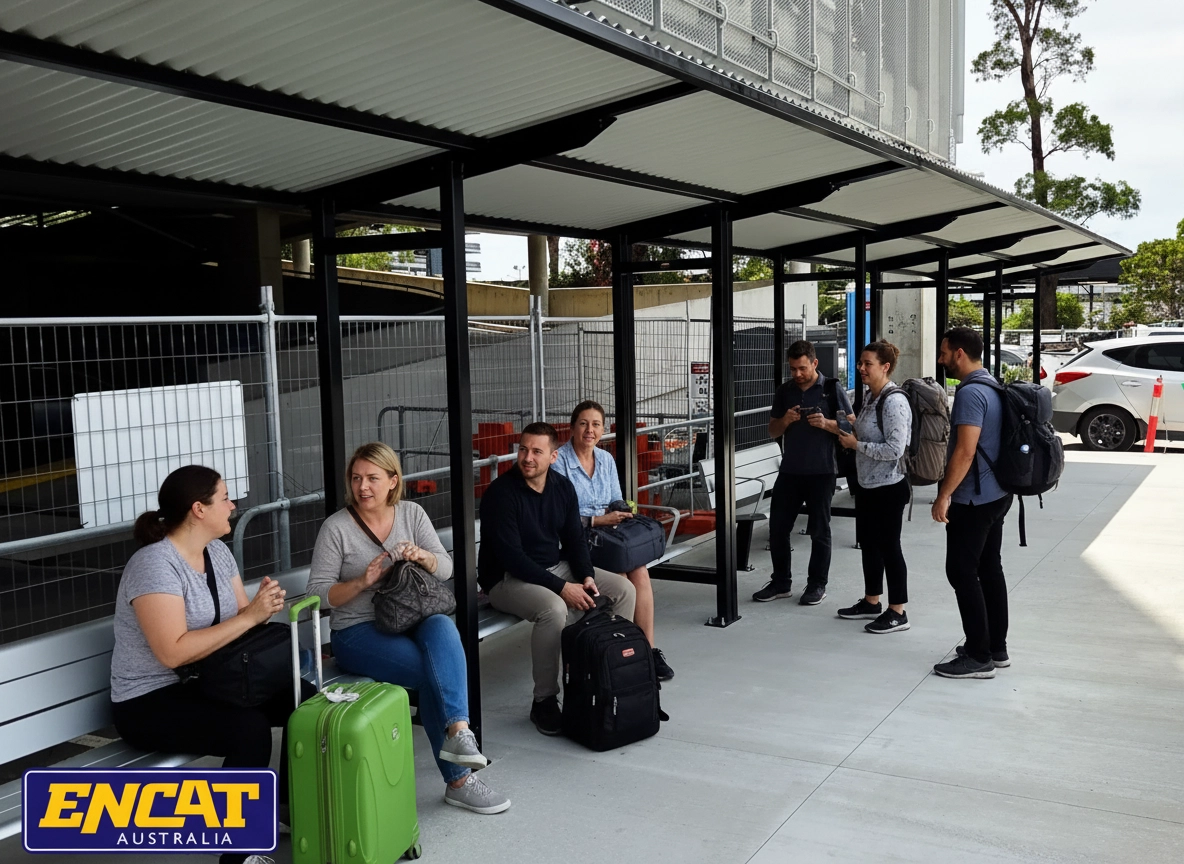
Bus shelter upgrades at T3 Domestic Terminal
ENCAT was engaged on the basis of our demonstrated capability to supply structurally certified, DDA-compliant bus shelter infrastructure and the track record we have at Sydney Airport itself having previously supplied shelters of the same design.

Bus shelter design, manufacture & install Central Coast NSW
Daracon Group engaged ENCAT to supply and install a public bus shelter as part of a residential subdivision development at Vicat Street, Boolaroo in Lake Macquarie New South Wales
Frequently asked questions about Sirius Double Bus Shelter
What is the difference between a bench seat and a DDA compliant seat?
A bench seat is a flat horizontal surface without back support or armrests. While common in older shelter installations, a bench seat does not meet DDA compliance requirements. A DDA compliant seat includes a backrest and armrests, enabling passengers with mobility impairments to seat and rise safely without assistance. ENCAT offers both configurations, however councils and government agencies specifying DDA compliant shelters will require the seat with back and armrests. If you are unsure which applies to your project, contact us and we can advise based on your location and the applicable requirements.
Is the Sirius the right shelter if my footpath is very narrow?
The Sirius Slimline Single has a base depth of 510mm on each side, making it one of the most compact DDA compliant bus shelters available in Australia. If you have a constrained footpath or verge width, the Slimline is the first product to consider. Contact us with your site dimensions and we can confirm whether it suits your envelope, or whether a custom solution is required.
Do you supply shelters to match an existing installation?
Yes. If you are adding to an existing ENCAT shelter installation, or need to match a non-ENCAT shelter for a streetscape consistency requirement, contact us with photos and dimensions of the existing structure and we will advise on the closest available match or the feasibility of a custom solution.
Can the shelter be relocated after installation?
Yes. ENCAT shelters are anchored to their slab using chemset fixings, which can be drilled out and reinstalled at a new location. The shelter itself — being fully steel and assembled — can be craned off the slab, transported, and reinstalled without structural modification in most cases. Contact us to discuss the requirements for a specific relocation.
What foundation is required for installation?
ENCAT shelters are anchored to a concrete slab using chemical set (chemset) fixings. The slab must be prepared prior to the installation date. ENCAT can advise on slab specification requirements based on the shelter model and site conditions. Concrete pad preparation and levelling works can be arranged as part of our installation scope on request.
Can lighting be added to the shelter?
Yes. Lighting provisions can be incorporated into the shelter structure during manufacture. Electrical connection and compliance is managed by the client’s licensed electrical contractor. If you know at the time of ordering that lighting will be required, advise us during the design stage so that conduit routing and mounting provisions can be included in the fabrication.
Can an advertising panel be incorporated?
Yes. ENCAT shelters can be manufactured with advertising panel provisions as standard. Contact us to discuss the panel configuration, size, and framing options relevant to the shelter model you are considering.
What happens if the shelter is damaged after installation — for example by a vehicle?
ENCAT supplies replacement components to councils and contractors for shelters damaged in service. Because everything is manufactured in-house from digital files, components can be reproduced to the original specification. On-site repair services are also available where structural assessment and remedial fabrication is required. Contact us with photos of the damage and we will advise on the most appropriate and cost-effective resolution.
Do you provide documentation for council asset registers or project quality files?
Yes. Structural engineering certification documentation is available for all shelters and can be provided in a format suitable for inclusion in council asset management systems, project quality files, or DA compliance submissions.
Have your shelters been independently tested or reviewed for vandalism resistance?
The ENCAT Sirius range has been in continuous production and service since 1989. Across more than 35 years and over 500 installations in New South Wales, the Sirius has not recorded a single vandalism incident. This is not a tested or certified claim — it is a documented service history across hundreds of real-world public installations. The all-steel construction, 2.6-metre height, open mesh rather than glass side panels, and the absence of components that are easily removed or damaged are the design decisions behind that record.